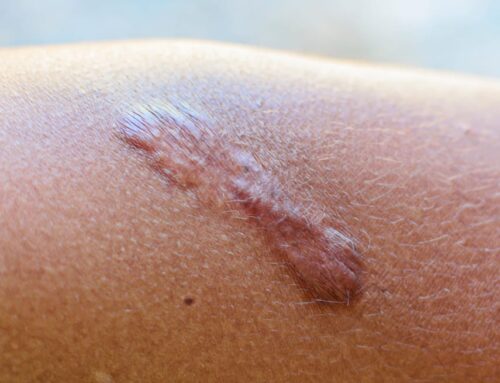
A tummy tuck (abdominoplasty) always leaves a scar. But how does it develop in the first year, and what can you do to help it heal better? Let’s look at how the scar changes and what treatments give the best long-term results.
What happens during a tummy tuck
During a tummy tuck, excess skin and fat are surgically removed to create a flatter, firmer abdomen. The procedure can be extensive, and recovery takes time. Because multiple skin layers are cut, the resulting scar often needs targeted aftercare to heal properly and reduce the risk of thick or painful scar tissue forming.
Where the tummy tuck scar is located
The main scar usually runs from hip to hip, low across the abdomen so it can be hidden under underwear. The scar after a mini tummy tuck is usually smaller and resembles a c-section scar.
In some cases, especially with a fleur-de-lis tummy tuck, there is also a vertical incision from the navel downward, creating an anchor-shaped scar.
What does a tummy tuck scar look like?
Aside from the location and shape, the look of your tummy tuck scar can change during the healing process. Although the scar is permanent, it fades and softens over time. You can also influence how well it heals with consistent scar treatment.
After the wound has closed, you will have a scar. It can look red and cause symptoms such as pain, itching and pulling of the skin. You can treat these symptoms with a scar cream.
After about 6 weeks, the scar can remain the same, or develop into an abnormal scar. An abnormal scar is usually red, raised and firm. Abnormal scars such as hypertrophic and keloid scars do not heal or fade on their own and require active treatment.
Your tummy tuck scar after 1 year
While some scars may fade on their own, due to the cause of a tummy tuck scar, this is unlikely to happen. There are several factors that influence what your scar will look like after 6 months, 1 year and even 1,5 to 2 years after surgery.
The most important factor that affects you after a tummy tuck, is the cause of your scar. Your scar is caused by a surgery. Scars after a surgery have a 50% chance to become hypertrophic (red, raised and firm). This is because a surgeon makes an incision and cuts through all layers of the skin.
The resulting scar tissue is more prone to develop into an abnormal scar. This can also happen even 6 months after wound healing. Until after about 1,5–2 years, when the scar has matured, there is still a risk of an abnormal scar developing.
So how do you improve the look of your tummy tuck scar or prevent an abnormal scar? Start with scar treatment specifically optimised for after your surgery:
Treat your scar with silicone sheets
Once the wound is fully closed and the stitches or scabs are gone, start with your professional scar treatment: silicone scar sheets.
Silicone therapy has been the gold standard in scar management for over 20 years. It’s clinically proven to reduce redness, itching, tightness and thickening of scar tissue.
As it is a cosmetic procedure, there are silicone scar sheets specifically designed for your tummy tuck scar.
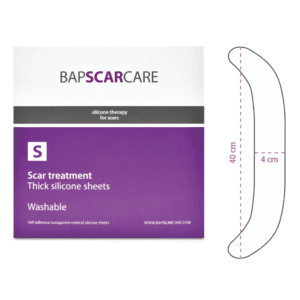
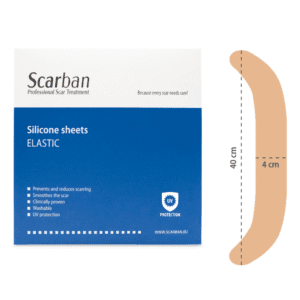
After your wound is closed, begin silicone therapy about four weeks later. Use it daily for as long as the scar remains active, usually up to 12 to 18 months.
What silicone sheets do
Medical silicone sheets like BAPSCARCARE S or Scarban Elastic & Light form a breathable layer over the scar. This layer reduces water loss from the skin and creates a balanced healing environment. The result:
Scarban also provides built-in UV protection, which helps prevent pigmentation or darkening of the scar.
Can you still use silicone sheets after one year?
Yes. If your scar is still active (red, raised, or itchy), silicone therapy can still improve the result. Even when the scar is mature, silicone sheets help keep the skin soft and flexible, which reduces pulling or pain around the area.